Designing a DMCC compliant subscription management system.
The UK’s Digital Markets, Competition and Consumers (DMCC) Act requires that companies offer consumers the ability to easily cancel a subscription. The cancellation process must be as simple as the sign up process.
The Times newspaper needed to build a subscription management service that was fully compliant with national legislation. However, the business also needed to try and retain as many customers as possible. The challenge was to minimise cancellations whilst also complying with legislation.
Some details of this project are currently under NDA. By browsing this portfolio piece you agree to respect the privacy of any company data displayed and may not put it to any use other than to understand the work carried out. For further information, please get in touch.
Discovery
Understanding legislation details, business objectives, subscription models and the newspaper’s design system.
DMCC Regulations in detail
The Digital Markets, Competition and Consumers Act 2024 is the UK's response to "subscription trap" practices. It gives UK authorities the power to fine companies up to 10% of their global turnover. The legislation requires;
Clear, unhidden pre-contract information (price, renewal terms, cancellation method — not buried in T&Cs or behind links);
Proactive reminder notifications before a free trial converts or a long-term contract auto-renews;
A 14-day cooling-off window where users can cancel penalty-free, both at initial sign-up and at each renewal point.
From a UX perspective, the regulation translates simply to creating an "easy exit". In particular, cancellation must require no more effort than sign-up, and must be completable through the same channel the contract was entered in (i.e. no forcing a phone call to cancel an online subscription).
The Times newspaper allows users to subscribe online, therefore online cancellation flows, renewal reminders, and pricing transparency are no longer a "nice to have" bit of UX. They are now a compliance-critical part of design, which, if implemented incorrectly, carry direct financial risk attached — making them a legitimate and defensible design constraint to showcase, not just a dark-pattern-avoidance talking point.
Conflicting Business Interests
In today’s world, traditional press faces significant competition from free social and news alternatives. The Times has strong commercial incentive to keep users engaged through friction and intervention rather than transparency alone.
The business needed a design that demonstrated ethical, honest, low-friction cancellation flows that complies with DMCC legislation, whilst also retaining as many subscribers as possible.
The business planned retention strategies such as;
Discounts for long term subscription commitments
Temporary free periods for disengaged customers
Alternative subscription package offers during cancellation
My role was to balance legislative compliance with reasonable efforts to retain and win back customers. I had to educate the client about dark pattern UX design and use customer data to ensure that only relevant reasons to retain a subscription were offered. For example, if a user was paying for a feature they rarely used, an offer to stop paying for that feature and reduce monthly fees was displayed, alongside some information about the benefits of said feature.
The deeper conflict was around reminders and renewal notices. Nudging readers to appreciate journalism before they leave depended on timely, persuasive touch points, but the DMCC requires those touch points to be neutral, informational, and easy to act on, not converted into soft retention marketing.
Delivery
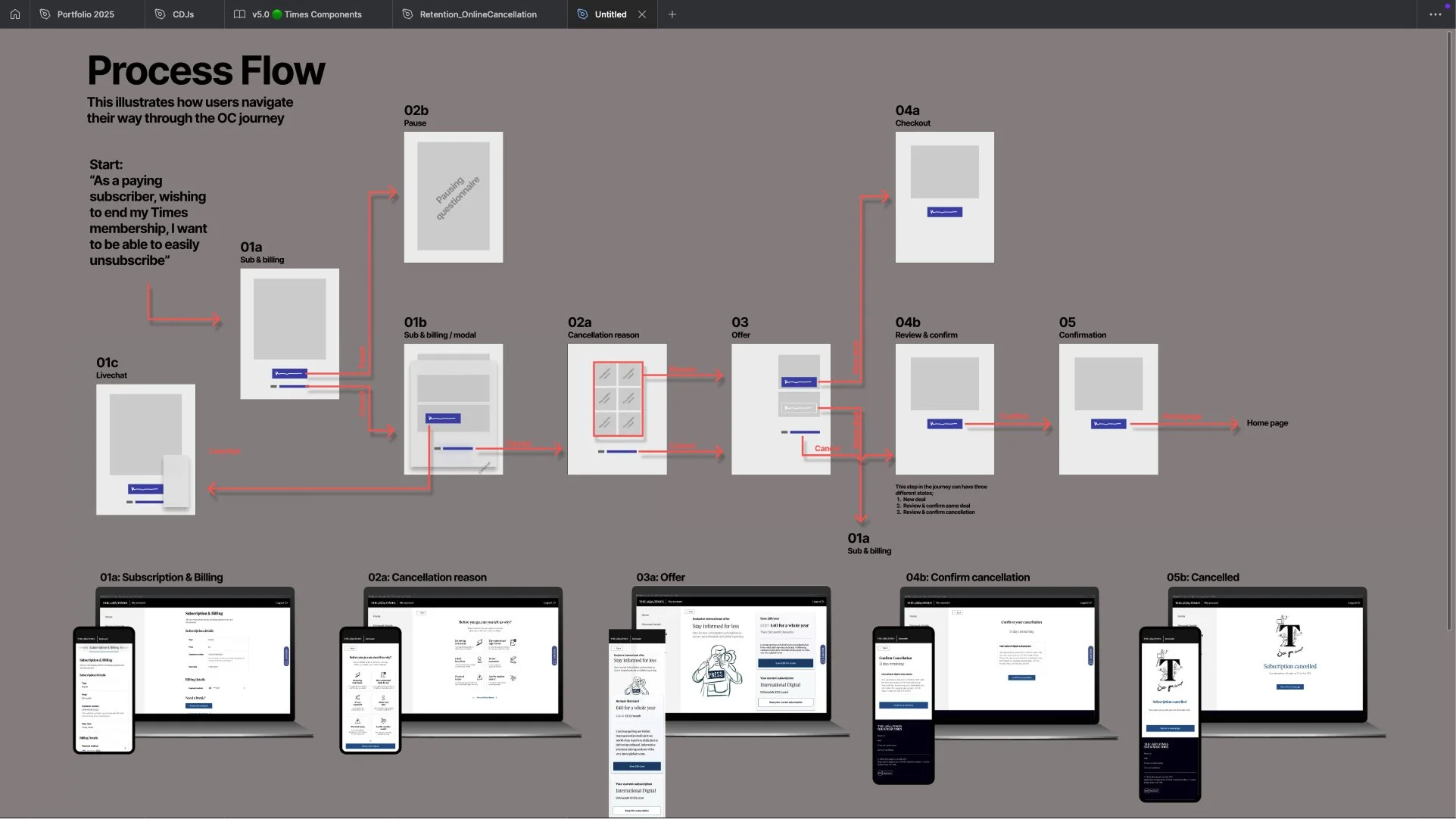
Designing a process flow that allows users to easily unsubscribe, take time off, downgrade or change their subscription type.
Related projects